
Hope Is Not A Distribution Strategy
This essay was originally published in IndieWire as the third in a series of columns, "The Producer's Path." It's been lightly adapted for republication here.
"I wish you would have called us a year ago..."
The exact words a distributor told us when we showed them our film. They would have suggested different actors, a different budget, and some changes to the story that would help them bring the film to market. As it was, they couldn't say yes, even if they wanted to, because we made something they couldn't sell.
This happens all the time. A producer makes a film from a solid script with great performances that's festival ready. Then they hit the circuit hoping to land a distribution deal. When they leave empty handed, it's a gut punch. They did everything "right," just not all of the right things. There's often a misalignment with budget, or the film doesn't deliver on the promise it made with the trailer and the first ten minutes.
The film reaches the end of the track with nowhere to go. Only at this moment does the filmmaker realize they can't get on a different track, and it's too late. It's not because the film is bad, it's because it was built on the wrong track, without ever consulting the people whose job it is to get it to an audience.
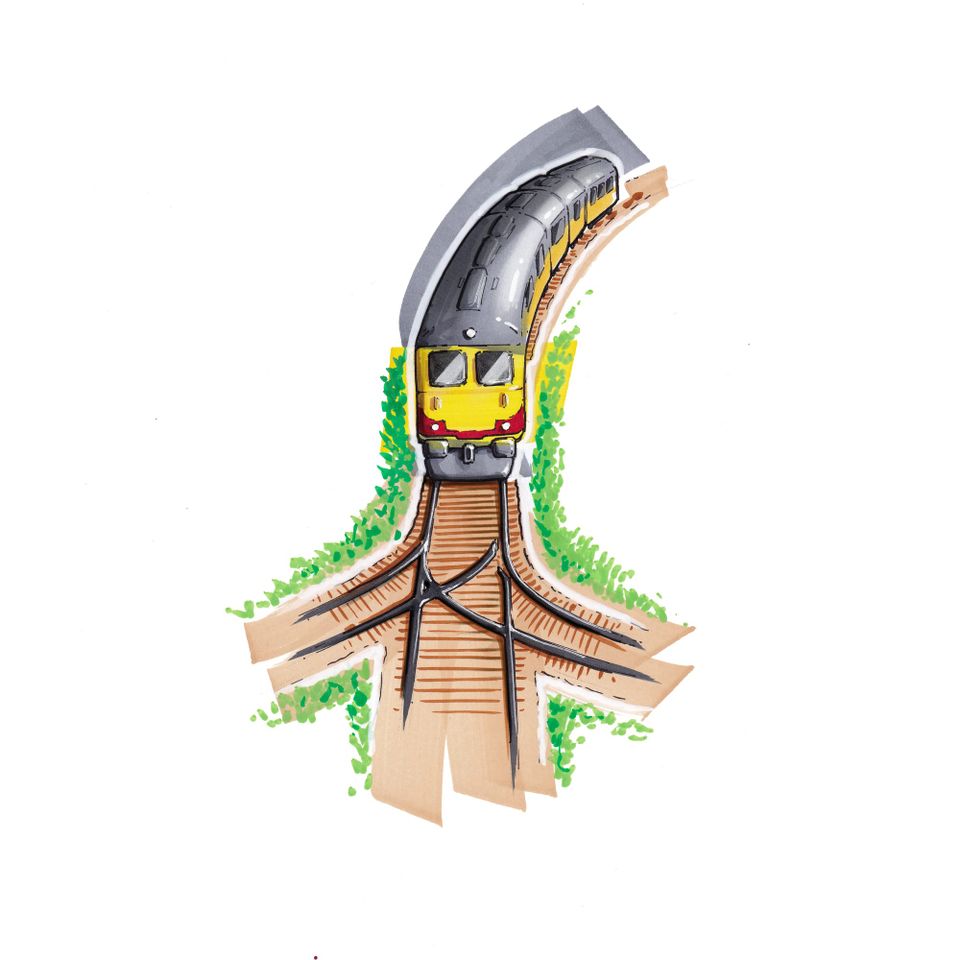
There are three tracks an independent film can travel from inception to market. Which one you're on is determined before you ever roll cameras, and you can't switch tracks once you've started.
Track One: The Hope Track
This is the unfinished railroad. You're asking your filmmaker friends to help you build a train, push it down the track, and then lay the track as you go, hoping it ends up at the destination. This is, unfortunately, the track most indie films are on. Most in this budget range are under $500,000, but even some million-dollar films start on this track. There's no distribution plan, no market validation, and the entire journey is powered by passion and hope: hoping you raise the money, hope you make a good film, hope it gets into a festival, hope someone buys it.
Again: hope is a terrible strategy.
Two of my first four films I worked on as a producer were on this track. These were $750,000 and $950,000 budgets. I can remember, vividly, the moment the track ran out. We were done with production, short for what we needed to finish post, and there was no plan for what came next. On the last day the costume designer asked me, "So when is this coming out? Where will we be able to see it?"
I had no clue.
Even a film with a name director, with family ties to one of the largest film festivals in the world, failed to get into that festival. So they submitted to others, and others, and others. A year and a half later it got into the Toronto International Film Festival, my best guess is because one of our actors had a decent role in Stranger Things that year and that was enough to get us into the festival's programming. What Comes Around sold to IFC Films, not because that was the plan, but because we got lucky.
If you bought an airline ticket from Los Angeles to New York City, and your boarding pass said "I hope...", how would you feel about that purchase? You'd instantly ask for your money back, and then tell all your friends to avoid that airline. And yet, we wonder why we struggle getting investors to back our films that are on this first track.
Track One only serves one audience — the filmmaker. It doesn't serve the investor (no plan to recoup their money), the distributor (we hope there's an audience for this movie), or the audience (we hope you can watch this someday).
Track Two: The Aligned Track
This track is complete from departure to destination. These films fall in the $1 million to $3 million range. The difference isn't just money, it's that the track exists before the train ever leaves the station. We know where we're going.
What this looks like in practice is that the distributor is consulted before the film is shot, ideally before the film is even greenlit. We know how the investor gets their money back (with interest). The audience demand has been identified and validated.
The main difference is the conversations the Track Two producer has before the movie enters development. In the initial conversations after they have answered the three questions I shared in my first column — is there leverage, am I compelled, and is it inevitable — the producer checks with distributors, marketers, production companies, sponsors, and sales agents to make sure they are on the right track, that they're getting on the right train. As soon as someone says, "Oh, that train doesn't go there," they stop and regroup. That may mean different partners, different actors, different budget, different script. But before they hop on the train, they know where it's going and that it's got as good a shot as ever to reach that destination.
Yes, you literally call a distributor in your network and tell them about your next project and ask them what they think. They will tell you whether they think it will work or not. That one conversation changes everything downstream. It impacts who you cast, because you now know who your audience is excited to see in a movie in that genre, and who carries more value in the marketplace. It changes your budget, because you know how much historical demand there is based on the data. It even changes your crew. You need people who have Track Two credits, who understand how to make and deliver a Track Two movie. Your cinematographer, production designer, your actors. If the entire infrastructure looks like a Track One movie, no investor or distributor will touch it. You can't jump the track.
Packaging is the biggest signal of whether you're making a Track One or a Track Two movie. You may feel a sense of loyalty to your partners or your crew, but if you want to make a Track Two movie, you need to make it with Track Two filmmakers.
Distributors and audiences read signals before they ever read scripts. If the signal says "Track One," you're stuck. Track One says "this is a movie for me." Track Two says, "this movie is designed for everyone."
That's what architecture in filmmaking looks like.
Track Three: The Leveraged Track
This is the bullet train. Budgets range from $3 million to $10 million for indies on this track. You're not building a track or a train yourself. This is a completely separate track meant for speed to destination. The train itself is dynamic, optimized, and proven. You're boarding a train built by a distributor, or a production company, or a brand that has way more leverage than you do.
This is packaging on another level. You bring your project, some equity along with it, and the willingness to approach bigger partners before greenlight to ask if you're holding a ticket that gets you on the train.
I spoke with a big distributor recently who told me, "The equity is the hardest part. If you can bring a great project with some equity and with you attached, we can help you package the rest and get you the rest of the money you need." Oddly, another production company, speaking about the same project, said, "you're too late for us. You've already got the writer/director, the script, and some actors attached. We want to come in earlier than that." This isn't a contradiction. They were both telling me "you're on Track Two. We're on Track Three."
The leverage can only come if you approach them early enough in the process. At that point it's not selling, it's inviting. You're presenting a ticket that they may want to punch. Getting on a train that's on Track Three ensures not only you'll get to the destination, but that you'll have less friction, fewer stops, and a more comfortable journey.
The catch here is that Track Three requires Track Three elements in the package. An established actor (or a few), writer, director, or intellectual property. You earn access to this track by executing Track Two films successfully, which increases your value in future packaging.
The Rule: You can't jump tracks
Wherever you start is where you'll end up. A Track One film with a Track One budget, cast, and story will not magically end up with an incredible Track-Two style distribution plan. Even if the film turns out great, it will still struggle to find the intended audience.
If the project is structured as a low six-figure passion project with zero market validation and no plan to go to market, the best outcome it can hope for is a Track One outcome. At some point, you run out of track. Our first film got into a festival, got bought by IFC Films, and then made $5,935 in theaters. We ran out of track.
The fourth film, Faith of Angels — a Track Two film — did $570,000 in theaters because it was designed from the start as a Track Two film. We had a distributor interested before the film was shot, minimum guarantees from other downstream channels, and a built-in audience of fans of the genre, the cast, and the writer-director. The economic reality of a Track One film doesn't care about who's in the movie, who directed the movie, or how good the movie is.
Track One films often never even leave the station. You can tell the filmmaker has spent years and a countless amount of emotional and mental energy on building this train. But they never spent any time thinking about what track they were building on. When they encounter Track Two investors and distributors, they struggle to get their attention for more than a moment, because they can see at a glance it's a Track One film. It's so clear to them, but you can't see it because nobody ever told you there was more than one track.
The system never taught producers these tracks exist. Film school teaches you how to make a film but says nothing of these different tracks. It's so frustrating — I know, it took me 12 years till I was hired to produce a movie, and the first three were Track One films. Only after the fourth film did I realize there was another track, and only in the last few months have I discovered that there's a third.
The question to ask yourself right now isn't whether your film is good enough. It's: am I aligned on Track Two, or am I hoping on Track One?
Knowing the tracks exist is one thing. Building a sustainable, profitable career is another.
It's not a single decision. It's a way of approaching every decision in development, financing, packaging, and distribution. And right now, almost no one is teaching it. Film school doesn't. Most producer workshops don't. The institutions that should be teaching this are too invested in the old model to admit it's broken.
So you have two options.
You can spend the next several years figuring it out alone, project by project, expensive mistake by expensive mistake, the way I did. Or you can compress that learning curve by getting in a room with other producers already doing the work.
That's what Craftsman Films is.
We're a working studio. Brotherhood is in production right now as a Track Two film, and we're documenting every decision in real time. Producer Fund I is deploying $10M across a slate of similarly-budgeted Track Two and Three projects. The membership is how we let other serious producers into the room while we build it.
The first 14 days are free.